Як комісіонеру захистити право на відшкодування понесених ним витрат за договором комісії без нарахування ПДВ на такі витрати

Тішуся, що нещодавно за моєї адвокатської підтримки успішно завершилася кількарічна епопея ряду ідентичних судових справ із органами податкової служби. Успіх трішки змазаний тим, що стосовно проблемного питання не вдалося отримати остаточний правовий висновок Верховного Суду (були лише ухвали про відмови у відкритті касаційних проваджень за касаційними скаргами ДПС). Та все ж є сподівання на те, що платникам податків стане трохи простіше.

Коротко суть проблеми.

Комісіонер брав у комітента за договором комісії товари (продукти харчування), реалізовував їх на експорт, після чого проводив з комітентом розрахунки за товари. На міжнародні перевезення товарів комісіонер ніс витрати, залучаючи перевізників. Такі витрати комітент в подальшому відшкодовував комісіонеру – це було передбачено і договором, і випливає зі ст. 1024 ЦК України. Причому відшкодовував комітент комісіонеру витрати «один до одного», що як би логічно: скільки комісіонер потратив на перевізника – стільки комітент і відшкодував комісіонеру.

Але податківці вважали, що насправді комісіонер «опосередковано» надавав комітенту послуги по перевезенню, тож зобов’язаний був нараховувати на ці послуги 20% ПДВ. Хоча, по-перше, жодних таких послуг комісіонер комітенту не надавав, бо навіть вантажного транспорту свого не мав, не кажучи вже про ліцензію на міжнародні перевезення; а по-друге, послуги з міжнародного перевезення оподатковуються ПДВ за ставкою 0%.

Було кілька ідентичних судових справ, і всі завершилися успішно для підприємства. True, одну з них Верховний Суд свого часу таки завернув на новий розгляд – але і під час нового розгляду підприємство довело свою правоту: відшкодування комітентом комісіонеру витрат на транспортування продукції – це не надання послуг. Витрати – це витрати, а послуги – це послуги. Ключове – це оформляти такі витрати саме як відшкодування витрат:

1) затверджений комітентом звіт комісіонера із переліком документально підтверджених витрат, обґрунтуванням їх необхідності та проханням схвалити і відшкодувати їх;

2) акт про відшкодування комісіонеру понесених витрат;

3) платіжна інструкція з відповідним призначенням платежу – «відшкодування транспортних витрат».

Коли я починав ці справи, то судової практики було геть небагато. Причому досвідчені бухгалтери співчутливо дивилися на мої аргументи. У фейсбучних бухгалтерсько-аудиторських групах, куди я звертався із проблемою, моєму допису ставили сумні смайлики. А після успішного завершення першої справи штучний інтелект мені сказав щось на кшталт «Ти правий, ось судова практика, яка підтверджує твої доводи» – і дав мені посилання на рішення суду першої інстанції у моїй же справі, чим неабияк мене здивував і водночас потішив.

Якщо когось цікавлять номери справ – 140/33468/23; 140/4613/24; 140/6105/24.

Хоча перевірок було не три, а чотири – але одне ППР скасувала самостійно ДПС України. Чим здивувала і потішила мене ще більше, ніж штучний інтелект.

05 березня 2026 year

ШІ ПРОТИ СУДДІ: ХТО БІЛЬШИЙ ФОРМАЛІСТ?

Прочитав статтю GPT-5 здобув перемогу над суддями-людьми у юридичному протистоянні.

І цікаво, і небезпечно.

Судова система в більшості державце одна з найконсервативніших гілок влади. Але рано чи пізно більшість розвинених країн зіштовхнеться з викликомнаскільки глибоко можна допускати ШІ до інтеграції з судочинством? Нині ШІ вже сприймається прогресивними суддями, як хороший допоміжний інструмент (перевірка правових позицій, пошук релевантної судової практики, наукових підходів, підготовка тез процесуальних документів, навіть первинний аналіз доказів і т.п.). Але інша справаце наділити ШІ функціоналом приймати рішення. До цього судова влада ще не готова, і причини цього є різніяк глобальні, так і особисті.

У статті підкреслюється, що ШІ демонструє схильність до жорсткого формалізму. For example, судова практика Верховного Суду не схвалює так званийнадмірний формалізм”, але інколи важко провести межу між надмірним формалізмом і необхідним дотриманням процесуальних норм. Нерідко нехтування суддями процесуальними нормами спричиняє те, що в подальшому сторони чи представники просто перестають виконувати ці норми. А навіщо їх виконувати, якщо суд і так задовольнить клопотання/долучить докази/відкладе судове засідання?

ШІ хоч і мовна модель, але сприймає норми законів і кодексів, як математичне правило, котре не можне порушувати. Відповідно, алгоритми ШІзаточеніна дотримання алгоритмів-процедур, звідси й жорсткий формалізм. Але ілюдськийВерховний Суд демонструє приклади, коли в питаннях формалізму міг би дати фору навіть найбільш формалізованому ШІ. For example, щодо обрання належного способу захисту позивачем своїх прав. So, мене нерідко бентежать категоричні висновки Верховного Суду про те, що у такій-то справі позивачем неправильно обрано спосіб захисту права – for example, визнання недійсним правочину. Тож через кілька років судових процесів Верховний Суд каже, що позивач ніби й правий, але визнання договору недійсним є неефективним способом захисту прав позивача. А тому в позові слід відмовити.

Нерідко це викликає подив і скепсис. Адже десятиліттями визнання недійсними договорів в аналогічних справах ефективно відновлювало права позивачів. То чому Верховний Суд категорично вирішує, що саме в цій справі такий самий спосіб захистуненалежний і неефективний? Навіть у математиці (з її ультраточнимнадмірним формалізмом”) цілком можливо вирішувати різними шляхами математичні рівняння чи доводити теореми. То чому в питаннях права належним і ефективним способом захисту може бути лише математично точно вивірена словесна конструкція прохальної частини позовуі ніяк інакше?

Формулюванняненалежно обраний спосіб захисту праваз’явилося спочатку в господарському судочинстві. І складається таке враження (хотілося б вірити, що воно хибне), що це проявлялося передусім у справах, де позивач був дійсно правий, але суд, керуючись не законом, а іншими факторами, шукав спосіб відмовити у позові. А в подальшому ця конструкція увійшла в інші форми судочинства.

Ago, повертаючись до ШІ та формалізмупросто цікаво, як би такі ситуаціїрозрулювавШІ?

А ще цікаво, кого б обрали підсудні: ШІ, чи присяжних?

16 лютого 2026 year

UNNORMAL FRAUD RATE

A private contractor once said: "For me, all people are divided into two categories: collectors and debtors". Not wonderful, that a significant part of disputes and court cases is related to that, that someone owes someone something, and there is a creditor, and there is a debtor.

As long as I remember my legal path - to debtors, who contacted qualified lawyers in a timely manner, it was always easier to avoid foreclosures in favor of creditor opponents. The property of debtors was encumbered by friendly creditors, was transferred to the authorized capital, or it was alienated in favor of relatives – and in the end the debtor had no assets left, which would enable the creditor to get what he wanted, at least partially. Often, the court's decision on the satisfaction of the claim and the collection of funds in favor of the plaintiff remained only a few sheets of paper with a seal.

But in 2018 the concept of "fraudulent transaction" appeared. In short, then the fraudulent transaction is a contract, which is committed by the debtor with the purpose of evading obligations to the creditor. For example, if the debtor, to avoid foreclosure on the apartment, gave or sold it to his mother - this contract has signs of fraud, i.e. such, which is committed with the purpose of causing damage to the creditor.

In national legislation, the concept of "fraudulent act" is contained only in the Bankruptcy Code, accepted by 2018 year, and even there it is mentioned very superficially. To 2018 year, I did not find any court decision, which would contain a reference to a fraudulent transaction. Although occasionally there have been cases in judicial practice, when the courts qualified, as fictitious, negotiate, entered into in order to avoid the fulfillment of a monetary obligation. But starting with 2019 year, The Supreme Court managed to actually change the legislation, without changing it in essence. Judicial practice introduced the concept of fraudulent transaction in civil law (contract), as a kind of fictitious deeds.

That's good, is it bad, that the Supreme Court undertakes to clarify the law in this way - points of view may differ. But in the context of such general principles of civil legislation, as justice, good faith and reasonableness, this approach of the Court appears to be, which is aimed at real protection and protection of civil rights.

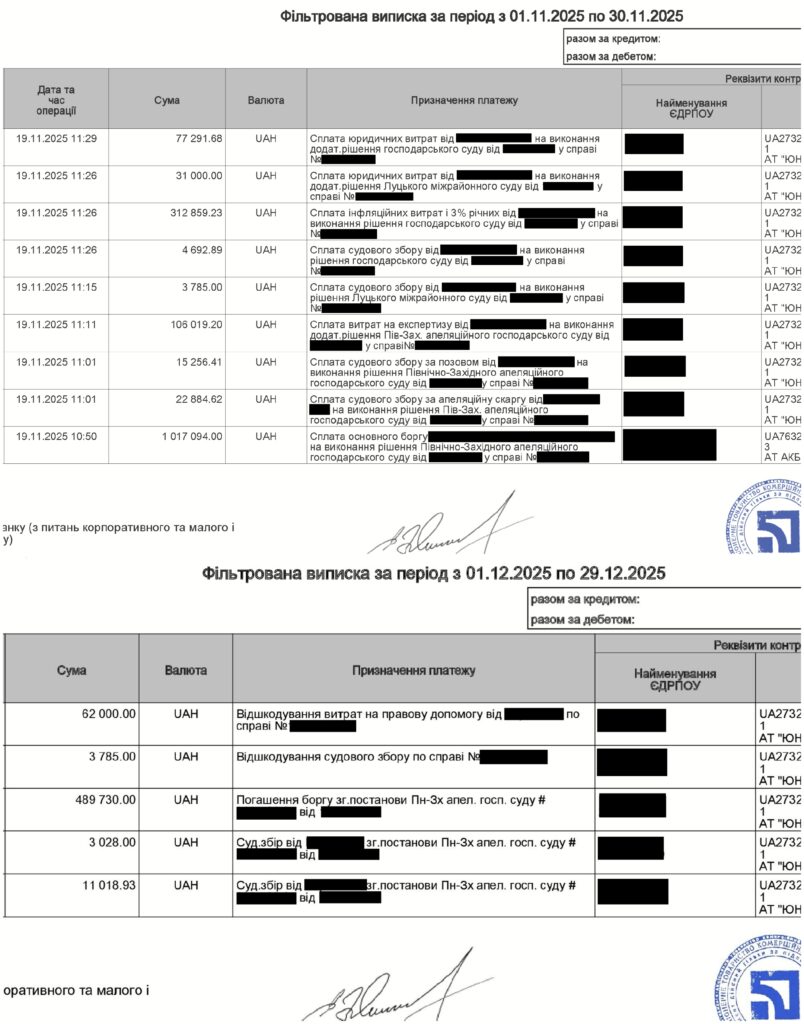
Recently, a colleague and I conducted a number of interrelated court cases, which arose in connection with that, that from the company's account (our client) funds were regularly withdrawn to FOPs. Several million hryvnias were thus withdrawn. The criminal part of this case is still being leisurely investigated by the police, no Supreme Court will help here. But I suggested to the client not to limit himself to criminal proceedings, and to state requirements to FOPs, who received money - but did not deliver any goods or services. Therefore, at first the client filed lawsuits for the recovery of the funds they unjustly received from the enterprise from the FOPs. It was not easy, but managed to convince the court of the validity of the stated demands. But while the trials were going on, the debtors entered into contracts, with which they transferred their real estate to relatives (it's a pity, the court refused to enforce the claim and impose a seizure or prohibition of alienation of the property). Therefore, the second step was to file lawsuits to invalidate fraudulent contracts. And then there was also the final nail of the chord - a foreclosure lawsuit 3% annual and inflationary losses.

And one fine day, funds started arriving in the client's account. Eventually the debts were paid. Including reimbursement of court costs, which the client incurred for legal aid, for paying court fees and conducting examinations:

And this is a vivid example, which demonstrates, that fraud, elevated by the Supreme Court to the rank of a rule of law, still works, protecting the interests of creditors.

True, sometimes i wonder: and whether the creditor would really receive real satisfaction, if you make a deal with me, as with a lawyer, the debtor would conclude first? 🙂

30 December 2025 year

DRIVING IN A DRUNK STATE: 0,2 PROMILE, OR 0,5? OWL, THE GLOBE AND THE VIENNA CONVENTION ON ROAD TRAFFIC

I recently read this link this article with a loud name "International law can be applied in Ukraine: permissible alcohol content for drivers 0,5 it's good - they proved it in court and got a decision". The article describes the situation, when according to the results of the examination of the driver in a medical institution it was established, that the alcohol content in the body was 0,25 smartly. Since the clause 7 of section II of Instructions No. 1452/735 dated 09.11.2015 the permissible content of alcohol in the driver's body is 0,2 smartly, and the "dose" found in the driver was higher - the court of first instance found the driver guilty (case #751/8189/24).

However, the Chernihiv Court of Appeal canceled decision of the local court and closed the case. There is such motivation in the decision of the appellate instance:

Article 8 point 5 of the Vienna Convention on road traffic from 08.11.1968, which was ratified by the Ukrainian USSR 25.04.1974, defined, that special provisions should be made in national legislation, which relate to driving under the influence of alcohol, as well as the legally permissible level of alcohol in the blood, and in appropriate cases – in the air, that is exhaled, exceeding which is incompatible with driving a vehicle. In all cases, the maximum level of alcohol in the blood in accordance with national legislation should not be exceeded 0,50 grams of pure alcohol per liter of blood or 0,25 mg. per liter of air, that is exhaled.

So, the minimum limit of alcohol content for determining the state of alcohol intoxication, according to the norms of international law should constitute 0,25 mg. per liter of air, that is exhaled, and, in the calculation of units of measurement of alcohol in blood and air, that is exhaled, is 0,5 smartly.

Therefore, taking into account the permissible error during the operation of the technical device, alcohol content in the air, that was exhaled by the driver PERSON_1 , did not exceed the maximum permissible norm, stipulated by the norms of international law.

But the court's conclusion is not entirely based on that, what is written in the Convention (Viennese, and not Vienna, by the way). Paragraph 6 (and no 5) articles 8 of this Convention reads as follows:

"In the national legislation need to predict special provisions, relating to driving under the influence of alcohol, as well as the legally permissible level of alcohol content in the blood, and in appropriate cases - in the air, that is exhaled, exceeding which is incompatible with driving a vehicle. In any case, the maximum level of alcohol content in the blood according to national legislation should not exceed 0,50 g of pure alcohol per liter of blood or 0,25 mg per liter of air, that is exhaled."

Therefore, the provision of the Convention mentioned by the court does not allow driving a car with the content of alcohol in the blood 0,5 smartly, and provides, that the member states of the Convention independently establish the permissible level of alcohol content, at the same time, it cannot be more, than 0,5 per milliliter in the blood. The Convention does not prohibit national authorities from setting lower alcohol levels, which is happening in Ukraine, where the minimum level of alcohol in the blood is established 0,2 smartly.

Why did the Chernihiv Court of Appeal allow such a sovonaglobusing with the Convention - a rhetorical question. As for me, in that case, the probable error of the device could be used to protect the driver (0.06), and not allow the essence of the Convention to be distorted. The justice of the council should be noted, that the majority of judges interpret the norms of the Convention quite correctly - for example, its absolutely correct interpretation was applied recently by the Khmelnytskyi Court of Appeal in another case.

Ago, if someone believes this phrase from the title of the article I mentioned: "...permissible alcohol content for drivers 0,5 smart..." - take your time. Advertising is one thing, but the realities are different.

25 September 2025 year
To what extent the idea of ​​calculation has the right to life 3% annual and inflationary losses "in advance"?

I will explain the point in more detail.

As is known, Article. 625 The Civil Code of Ukraine provides, what debtor, who overdue the payment of a monetary obligation, is obliged to pay the amount of the debt at the request of the creditor, taking into account the established inflation index, as well as 3% per annum from the overdue amount (unless another amount of interest is established by contract or law).

In practice, it happens somewhere like this: a foreclosure action is filed 500 thousand hryvnias, 50 thousand hryvnias of inflationary losses and 5 thousand hryvnias as 3% yearly (all monetary amounts are approximate). As a rule, inflationary losses and 3% per annum the plaintiff calculates as of the date of filing the claim (or to her).

But the court can consider the claim for six months, a year... During this time, too, it would be possible to count 3% annual and inflationary losses, but it is possible to increase the price of the claim only during the preparatory meeting (or before the start of the first court session, if the case is considered in the order of simplified legal proceedings), and not during the trial. And an idea arose: and what, if inflationary losses and 3% annual to declare for collection in an increased amount - "in advance" for several months? For example, as of the date of filing the claim, real inflationary losses amount to 50 thousand hryvnias, A 3% annual - and 5 thousand hryvnias. However, the plaintiff in the lawsuit doubles their amount, and declares for collection 100 thousand hryvnias of inflationary losses and 10 thousand hryvnias 3% yearly. And then the plaintiff regularly submits an updated calculation of the amount of the claim to the court (for example, on the date of each meeting, or every month, after the publication of the inflation index by the State Statistics Service).

Disadvantages of the scheme:

  1. You will have to pay a slightly larger court fee;
  2. It is necessary to write the court separately, why the calculation is exactly like this;
  3. There is a risk that the claim will not be fully satisfied, and partly, because if the court considers the case quickly, then at the time of the decision the amount of inflationary losses and 3% annual fees will not "reach" those declared by the plaintiff;
  4. If the defendant is a natural person and does not have an electronic office in the Unified Judicial Information Telecommunication System, the settlement of the claim will have to be sent by mail to the defendant every month.

Advantages of the scheme:

  1. The plaintiff may receive more, sometimes much more.

I personally think so, that the plaintiff is not deprived of the opportunity to file a claim for recovery 3% annual and inflationary losses "with a reserve for the future", as it does not contradict the requirements of procedural codes. Such an opportunity is indirectly provided to the plaintiff and in view of the provisions of ch. 10 Article. 256 Central Committee of Ukraine (h. 10 Article. 238 Code of Criminal Procedure of Ukraine), according to which court, making a decision on debt collection, on which interest or interest is accrued, may specify in the decision on the accrual of the relevant interest or penalty until the moment of execution of the decision, taking into account the prescriptions of the legislation of Ukraine, governing such accrual. Only in contrast to this norm, which is difficult to implement (it will not be easy to induce the executor to charge interest), option with declaration of inflationary losses and 3% yearly "in advance, with a margin" has the right to life. Because if the court can charge interest from the date of the decision, then the plaintiff has the right to charge such interest from the date of the decision (or close to this date).

21 July 2025 year

"Save" a broken marriage: About the claim, Not served, And what is the money here?

The Supreme Court has recently considered a deeds of marriage. Such cases infrequently reach the cassation instance, And in this case there was a feature: The complainant claimed, that she did not file a claim for divorce. Sometimes it happens, that the defendant does not know about the existence of a court case, But so that the plaintiff does not know about it is a rarity. Although it happens.

For example, In my practice was the case, in which the plaintiff did not even know about the existence of the trial initiated by her. So, to my client, The culprit of a small accident, A claim for damages and non -pecuniary damage has been filed. The claim was filed on behalf of the owner of another car, which was affected in an accident. The claim was justified and the amount of losses, and the size of moral harm, which was in the impossibility of plaintiffs to use the car regularly and use it in work. The interests of the plaintiff was represented by a lawyer.

But it turned out, that actually a car owned one young man (A relative of the plaintiff), which after an accident decided to "arrange a claim" on behalf of the plaintiff and earn a little. As a result, the court left the claim without consideration on the basis of a statement of the representative of the "plaintiff" (Although, in my opinion, It would be more correct to return the claim as such, that is signed by the person, who had no right to sign a claim).

As for the dissolution of the marriage without the knowledge of the plaintiff, it also had to hear some bearded stories about such cases. There is now an “action”, who can inform the person about, that such a person is a member of the court case. But not everyone has a “action”. Besides the "action" is possible failures. And is not excluded, that when submitting a claim will not be specified (or will be specified with an error) Rnokpp, to which “action” is tied. And often it turns out, that with the same name there are several different people. By the way, Once the court refused to open proceedings, with, According to the court received, The defendant died. And the defendant took and appeared in court for a ruling ... Sometimes.

Usually the judicial summary must deliver "UkrPoshta", but also for the quality of Ukrposhta's work there are many questions, and mailboxes are often destroyed or missing, and not always a person lives at that address, that is specified in the summons. And many people went abroad.
So I am every customer (including. potential) I recommend at least once a month to go on The site of the authorities and check, Is there any court cases with respect to him.

In a court case, which the Supreme Court was reviewed and which I mentioned at the beginning of this post, The plaintiff claimed, what is she in July 2022 year to court with a claim for divorce did not apply. So, probably, It can happen so, that in absentia court decision from 14.12.2022 About the dissolution of marriage can be canceled (The case is assigned to July 2025 year). And torn by such a decision marriage will be considered valid. If it came out, that after a court decision, a man had already married a different marriage - then this man would be considered such, married at the same time. And this phenomenon in the legal system of Ukraine is not welcome at all. And if this man was also an official or politician, this situation could do great harm to his reputation.

But something tells me, What is in the case, reviewed by the Supreme Court, the situation is woefully different. After all, the rather unique surname and first name of the husband-respondent in this case are mentioned on the Internet, V Books of memory among Ukrainian soldiers, who died in February 2023 year... As you know, close family members of a fallen soldier can receive 15 million in one-time cash assistance. And if the marriage is broken – the ex-wife will not receive such assistance.

Think, fellow lawyers will agree, that even despite the legal simplicity of divorce cases, Advocates should be carefully designed their relationship with customers as carefully as possible, who want to break marriage. Especially, If the customer is abroad. Who knows – can, After the marriage is dissolved, the plaintiff will change his mind, After all 15 millions of hryvnias.

Font matter

It would: does it matter, that for the font used in the document? And in fact there are many factors, affected fonts: this light / heavy readability, and overall visual perception of the document, and the number of sheets, and even the amount being spent toner. But this is not all, which should be considered when choosing a font.

Canadian businessman accused of forgery of property. Cheating discovered because, that the defendant used in documents, supposedly dating from the middle of the 1990s, Fonts, which appeared only in the early 2000s. This portal tells Ars Technica.

reportedly, we are talking about documents, which used fonts Calibri and Cambria. These fonts were developed in 2004 year, but is not widely used in Windows to 2007 year: Then with the release of Vista font Calibri replaced the standard Times New Roman font in a Microsoft Office.

With false papers trying to prove businessman, that the property, the Court had to remove it for payment of debts of the bankrupt company, owned by his wife and children, but it, therefore can not be deducted to cover debt.

Documents, are used as evidence of defendant, dating back to 1995 and 2004 years, but their text was printed font Calibri and Cambria - this is cheating and issued.

As a result of careless entrepreneurs still have to pay $6,5 million to creditors or to get rid of real estate. in addition, Now it also will have to answer before the law for forgery.

Therefore, think carefully about the choice of font in your next document 😉

Recovered from here

The quality of documents

Lawyer – this is, who writes on paper 10000 words and name it “brief”

Some practicing lawyers are committed procedural documents hiperlakonichnosti. Others, on the contrary: knowing, in each instance, the court may in some doubt (and what your rights are violated? And whether the chosen method of protecting the rights norms CC? And you just select the right jurisdiction?) is trying to predict everything in advance to write a procedural document. Someone else statement to the seriousness nashpyhuye many items of legislation, which, perhaps, and far from the situation – but definitely have to impress a client. Everyone has their own approach. pithiness, some say lawyers, although the sister of talent, but stepmother fee.

Personally, I've been working on the elaboration friendly, and, hope, clear and legal epistolary style and visual design materials, customers who prepare or sues. Therefore, all interested, concerning this topic. At the time, few useful tips found in the book “write, reduces”, However, the legal style has its own nuances.

And recently came across the author's blog lawyer Stanislav Kunyanskoho “Right out of water and mud”. Extremely successful recommendations practicing lawyer, which sometimes run counter to the settled patterns – but definitely with the times and the demands of today. Some are used in their activities.

Recommend colleagues to read.