UNNORMAL FRAUD RATE
A private contractor once said: "For me, all people are divided into two categories: collectors and debtors". Not wonderful, that a significant part of disputes and court cases is related to that, that someone owes someone something, and there is a creditor, and there is a debtor.
As long as I remember my legal path - to debtors, who contacted qualified lawyers in a timely manner, it was always easier to avoid foreclosures in favor of creditor opponents. The property of debtors was encumbered by friendly creditors, was transferred to the authorized capital, or it was alienated in favor of relatives – and in the end the debtor had no assets left, which would enable the creditor to get what he wanted, at least partially. Often, the court's decision on the satisfaction of the claim and the collection of funds in favor of the plaintiff remained only a few sheets of paper with a seal.
But in 2018 the concept of "fraudulent transaction" appeared. In short, then the fraudulent transaction is a contract, which is committed by the debtor with the purpose of evading obligations to the creditor. For example, if the debtor, to avoid foreclosure on the apartment, gave or sold it to his mother - this contract has signs of fraud, i.e. such, which is committed with the purpose of causing damage to the creditor.
In national legislation, the concept of "fraudulent act" is contained only in the Bankruptcy Code, accepted by 2018 year, and even there it is mentioned very superficially. To 2018 year, I did not find any court decision, which would contain a reference to a fraudulent transaction. Although occasionally there have been cases in judicial practice, when the courts qualified, as fictitious, negotiate, entered into in order to avoid the fulfillment of a monetary obligation. But starting with 2019 year, The Supreme Court managed to actually change the legislation, without changing it in essence. Judicial practice introduced the concept of fraudulent transaction in civil law (contract), as a kind of fictitious deeds.
That's good, is it bad, that the Supreme Court undertakes to clarify the law in this way - points of view may differ. But in the context of such general principles of civil legislation, as justice, good faith and reasonableness, this approach of the Court appears to be, which is aimed at real protection and protection of civil rights.
Recently, a colleague and I conducted a number of interrelated court cases, which arose in connection with that, that from the company's account (our client) funds were regularly withdrawn to FOPs. Several million hryvnias were thus withdrawn. The criminal part of this case is still being leisurely investigated by the police, no Supreme Court will help here. But I suggested to the client not to limit himself to criminal proceedings, and to state requirements to FOPs, who received money - but did not deliver any goods or services. Therefore, at first the client filed lawsuits for the recovery of the funds they unjustly received from the enterprise from the FOPs. It was not easy, but managed to convince the court of the validity of the stated demands. But while the trials were going on, the debtors entered into contracts, with which they transferred their real estate to relatives (it's a pity, the court refused to enforce the claim and impose a seizure or prohibition of alienation of the property). Therefore, the second step was to file lawsuits to invalidate fraudulent contracts. And then there was also the final nail of the chord - a foreclosure lawsuit 3% annual and inflationary losses.
And one fine day, funds started arriving in the client's account. Eventually the debts were paid. Including reimbursement of court costs, which the client incurred for legal aid, for paying court fees and conducting examinations:
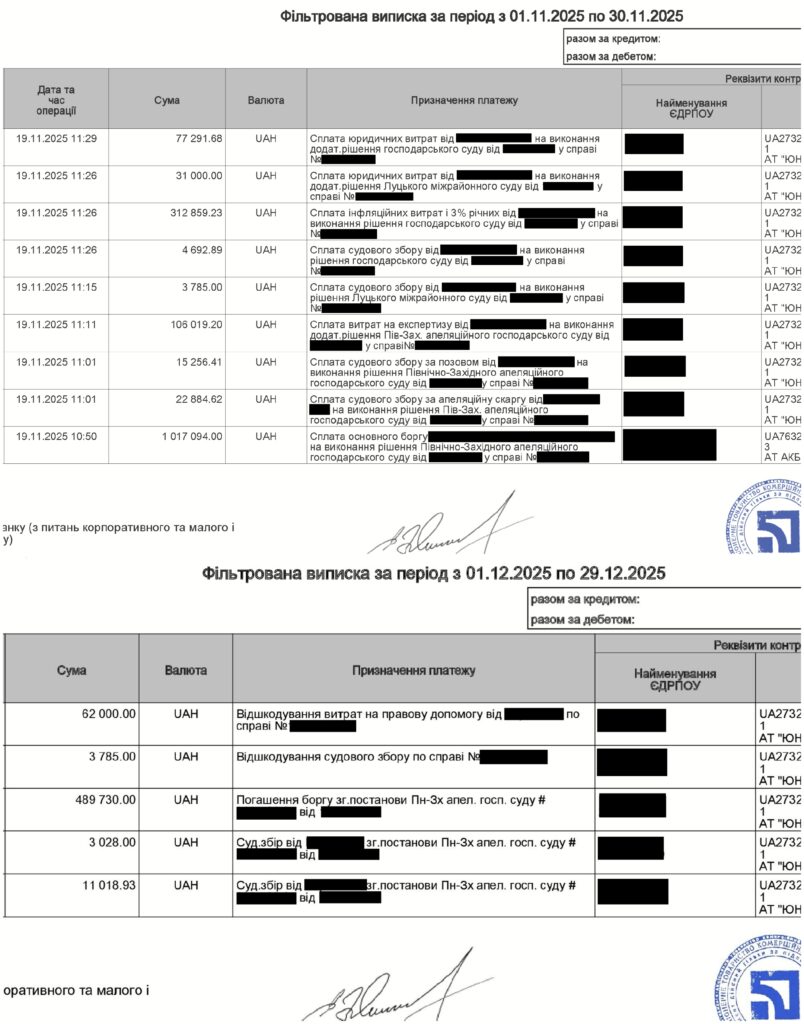
And this is a vivid example, which demonstrates, that fraud, elevated by the Supreme Court to the rank of a rule of law, still works, protecting the interests of creditors.
True, sometimes i wonder: and whether the creditor would really receive real satisfaction, if you make a deal with me, as with a lawyer, the debtor would conclude first? 🙂
30 December 2025 year
